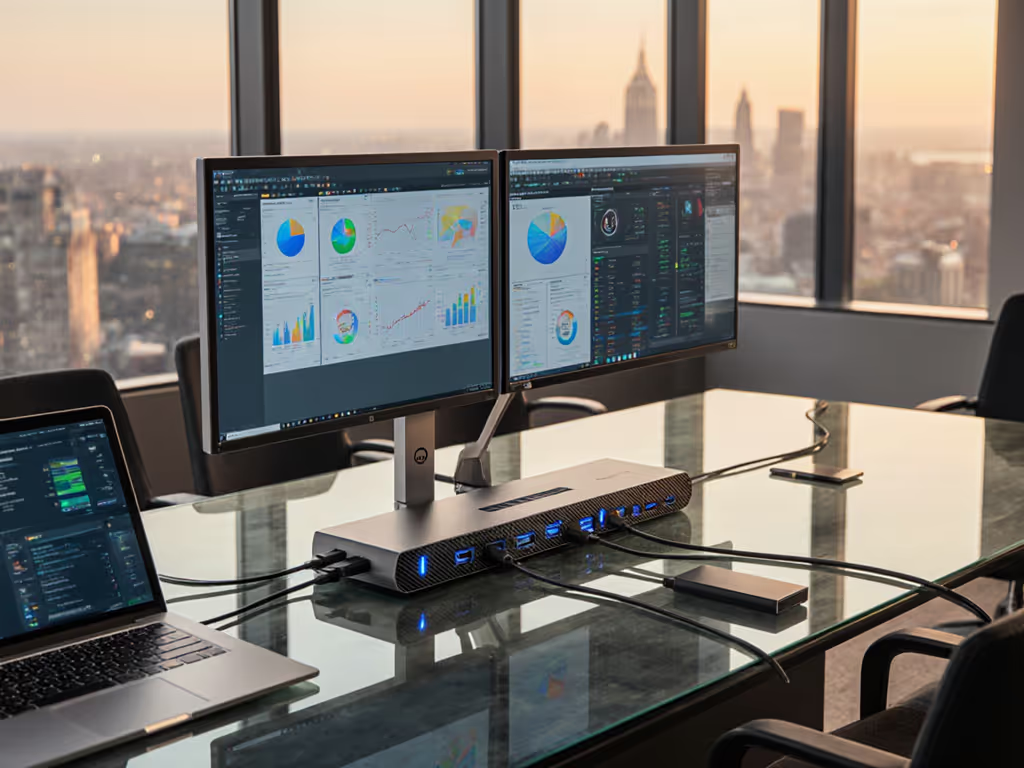
Plugable UD-7900 Review: Best Triple Monitor Dock?
By Anika Rao • 21st May
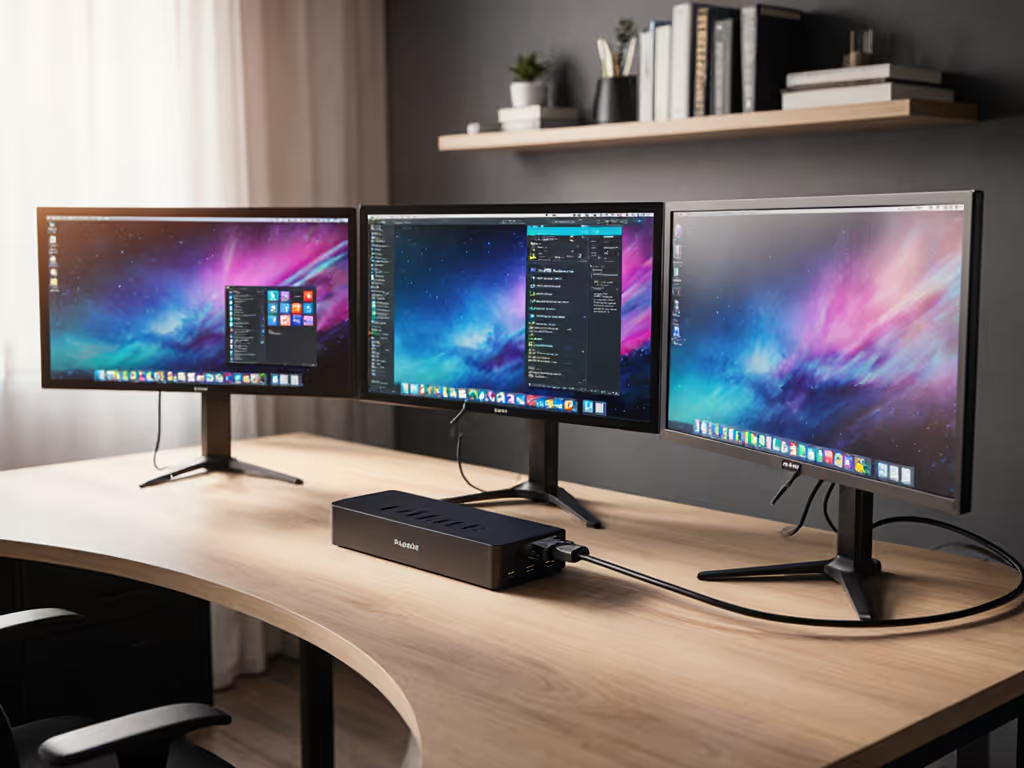
If you're here for a Plugable UD-7900 review, you're likely trying to standardize on a single "best triple monitor docking station" for a mixed fleet, without getting burned by surprise pixel limits, flaky drivers, or underpowered charging.
This isn't a hype piece. It's a risk assessment.
I'll walk through the UD-7900 as a class of product, USB-C/USB-A, DisplayLink-based triple-display dock, and compare it against other known Plugable options (and Thunderbolt 4 docks) so you can decide where, if anywhere, it belongs in your standard kit.
Pixels, power, ports - in that order.
1. What the UD-7900 Actually Is (Architecture, Not Marketing)
From Plugable's naming and product pattern, the UD-7900 sits in the family of "universal" USB-C / USB 3.x DisplayLink docks:
- Single upstream connection: USB-C (often compatible with USB-A via adapter) at 5-10 Gbps
- Multiple display outputs: marketed as triple-display capable (typically 3x HDMI or a mix of HDMI/DisplayPort)
- USB hub + Ethernet + audio: standard downstream ports and 1 GbE
- Designed to work across Windows, macOS, and sometimes ChromeOS with the DisplayLink driver stack
Key implications of that architecture:
- The dock does not rely on the laptop's native GPU outputs (DisplayPort Alt Mode + MST). Instead, the DisplayLink chipset compresses and tunnels display data over USB.
- This allows more displays than many laptops natively support, but adds a driver dependency and CPU/GPU load.
- It is almost certainly not Thunderbolt 4 / USB4 40 Gbps, so total bandwidth for displays + USB is bounded by 5-10 Gbps.
If your standard is "zero-driver, OS-native" docking, the UD-7900 fails that test before we even run pixel math. But if "multiple displays on anything, including M-series Macs" is your first requirement, this class of dock is exactly how vendors get there.
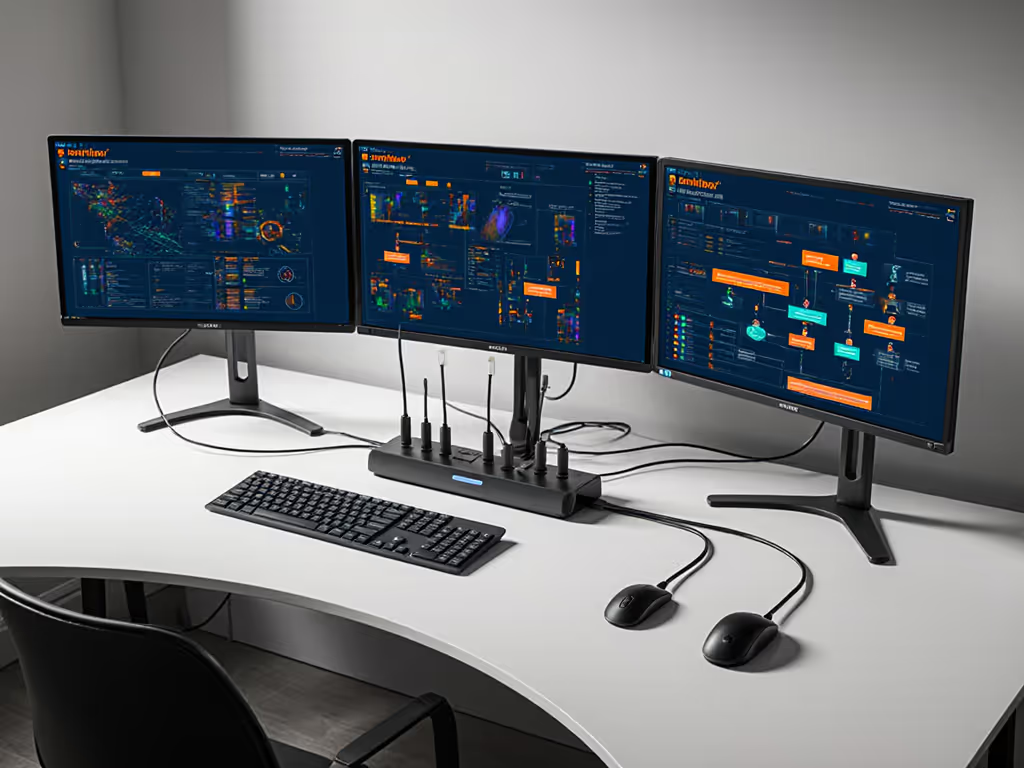
2. Triple Monitors by OS: Where UD-7900 Shines and Where It Breaks
Treat the UD-7900 as a DisplayLink triple-head dock. That's the right mental model for planning. If you're mapping ports and cables, our dual and triple monitor setup guide covers reliable hardware and software steps for Windows and macOS.
2.1 Expected behavior by platform
Use this table as a deployment hypothesis (exact details will depend on Plugable's final spec sheet and firmware, but these are typical for this class):
| Platform / GPU class | Native external display limit | What UD-7900 + DisplayLink can usually deliver* | Risk level |
|---|---|---|---|
| Windows 11 Pro, Intel/AMD integrated GPU (modern business laptops) | 2-3 | Up to 3 external displays (e.g., 3x 1080p or up to 2x 1440p + 1x 1080p) | Low-medium |
| Windows + dGPU (workstation/creator) | 3-4 | Triple external is fine; DisplayLink overhead is small | Low |
| macOS on Intel | 2-4 | UD-7900 can usually push 3 displays (mix of DL and native if you also use a direct port) | Medium |
| macOS on M1/M2/M3 non-Pro/Max | 1 native display | DisplayLink is the only way to get past the 1-display cap; 2-3 external usually possible with driver & security prompts | Medium-high |
| macOS on M1/M2/M3 Pro/Max | 2-4 | Triple should work, but macOS updates occasionally disrupt DisplayLink flows | Medium |
| ChromeOS | 1-2 | Triple sometimes possible, but ChromeOS support lags; treat as experimental | High |
| Linux (Ubuntu etc.) | 1-3 | Triple is possible with community effort, but not a low-touch rollout | Very high |
*Assumes modern CPU, up-to-date DisplayLink drivers, and moderate workloads.
Where UD-7900 is attractive:
- M1/M2/M3 base MacBooks where users demand more than one external display.
- Windows laptops limited to 1-2 native displays but your personas insist on a multi-monitor productivity setup (3x 1080p or 2x 1440p + 1x 1080p).
Where I'd be cautious:
- High-security macOS environments that lock down third-party extensions and screen capture permissions.
- Linux-heavy fleets without appetite for one-off tuning.
If you've ever watched "works on paper" triple-monitor rollouts dissolve into flicker and ticket storms, you already know the pattern: the OS, not the dock, is the weakest link until you introduce DisplayLink, and then the driver lifecycle becomes the new weak link.
3. Pixel Math and Performance: Can UD-7900 Handle Real Workloads?
Without an official spec sheet in front of us, we treat the UD-7900 as a 10 Gbps-class DisplayLink dock and run approximate math.
3.1 Pixel budgets
Baseline, uncompressed, 8-bit RGB:
- 1080p60 ≈ 3.2 Gbps
- 1440p60 ≈ 5.3 Gbps
- 4K60 ≈ 12 Gbps
DisplayLink uses adaptive compression, so it doesn't need full uncompressed bandwidth, but compression isn't magic:
- Three 1080p60 displays: Typically safe; this is what most triple-head USB docks are actually optimized for.
- Three 1440p60: Possible in theory, but you're now leaning heavily on compression and system CPU/GPU cycles.
- Any multi-4K triple setup: I'd treat this as marketing, not a stable baseline.
3.2 Practical configuration guidance
For UD-7900 performance benchmarks in your own lab, I'd test three realistic stacks rather than chasing theoretical max resolutions:
- Standard knowledge worker
- 2x 1080p + 1x 1080p (landscape)
- Office, Teams/Zoom, browser, 1-2 productivity apps
- Pass/fail: smooth window drag across all three, no visible compression artifacts on text, no audio pops.
- Data-heavy / trading-lite
- 2x 1440p + 1x 1080p
- Multiple browser sessions, BI dashboards, streaming financial feeds
- Pass/fail: no stutter scrolling dashboards, video keeps sync, CPU doesn't spike into thermal throttle.
- Creative workflow triple display (only if you must use this dock for creators)
- 1x 4K + 2x 1080p or 2x 1440p + 1x 1080p
- Light photo editing, timeline scrubbing in 1080p, color-critical review not recommended on DisplayLink outputs.
My bias: for serious creators, don't put their color-accurate panels behind a DisplayLink chain. If color accuracy and stable 4K timelines matter, see our docking stations for creatives comparison. Give them a Thunderbolt 4 dock with native DisplayPort/HDMI Alt Mode and reserve UD-7900-class docks for office, dev, and analytics personas.
If pixels stutter, we chase the bottleneck until silence.
DisplayLink docks like the UD-7900 are excellent at "more screens than the GPU natively supports", but they're not a replacement for native, fully uncompressed display paths when motion smoothness and color fidelity pay your users' salaries.
4. Power Delivery: Is UD-7900 a One-Cable Solution or Just a Display Expander?
Plugable's universal docks historically split into two camps:
- Display expander only: No laptop charging (like older UD-3900 variants).
- Full docking station: 60-100 W USB-C Power Delivery.
Without concrete numbers published for the UD-7900 here, you must treat PD capability and wattage as a gating factor.
4.1 What to verify on the spec sheet
Before you even consider standardization, verify: Not sure what wattage your laptops actually need? Start with our USB-C power delivery guide to avoid undercharging.
- Does UD-7900 provide USB-C Power Delivery to the host?
- At what sustained wattage? (Not peak, not marketing "up to" - sustained.)
- Is that per USB-C spec (20 V profile) and tested on your heaviest devices?
Then map that against your fleet:
- 65 W or less: Fine for thin-and-light knowledge workers, not for mobile workstations.
- 85-100 W: Adequate for most 14-16 inch business laptops (Dell Latitude, ThinkPad T/X, HP EliteBook) if you're not maxing CPU+GPU constantly.
- 100 W+: Needed for mobile workstations (Precision, ZBook, ThinkPad P) and some 16 inch MacBook Pros under heavy load.
If UD-7900 is sub-100 W or no PD at all, my recommendation:
- Use it as a secondary dock for users who already have a 90-130 W OEM charger on the desk.
- Do not position it as the primary "single-cable" experience; you'll accumulate slow-burn tickets about "battery draining while plugged in".
When we standardized a finance floor on triple displays, the project only stabilized after we moved to a TB4 dock with 100 W+ PD and short, certified cables. The extra capex was trivial next to the ticket burden and user frustration.
5. USB, Network, and Hot-Desk Behavior: The Non-Display Gotchas
Triple displays get all the attention, but USB stability and Ethernet behavior are where docks quietly ruin hot-desking.
5.1 USB throughput & contention
On a 5-10 Gbps upstream link, you're sharing bandwidth between:
- 2-3 compressed display streams
- USB storage (if any)
- Webcams, headsets, keyboards, card readers
For typical knowledge workers:
- Keyboards, mice, headsets, webcams are fine alongside triple 1080p.
- Don't hang high-throughput SSDs off a UD-7900-class dock and expect sustained write speeds while all three displays are busy.
If you have developers or data analysts moving large datasets regularly, give them either:
- A separate USB-C or TB port for storage, or
- A TB4 dock with 40 Gbps where display and storage can coexist more gracefully.
5.2 Ethernet reliability and manageability
Most Plugable universal docks provide 1 GbE via USB NIC. Questions to ask before rollout:
- Is it a common chipset (e.g., Realtek) with mature drivers on your OS baseline?
- Does your network team require MAC address pass-through or filtering? USB NICs sometimes complicate this.
- Do you depend on PXE boot or Wake-on-LAN at the dock? Many USB NICs don't support these reliably, especially across OS sleep states.
For hot-desking:
- Validate link-up time from plug-in to usable network on your standard images.
- Confirm VPN clients and 802.1X behave identically on the dock NIC as they do on the built-in port.
If you see link flaps or odd behavior during sleep/wake testing, I'd move critical users to a Thunderbolt dock or an OEM USB-C dock with better NIC integration rather than burn cycles debugging USB NIC edge cases.
6. Drivers, Updates, and Fleet Risk: DisplayLink vs Native Alt Mode
DisplayLink is both the UD-7900's superpower and its Achilles' heel.
6.1 What DisplayLink buys you
- Extra displays beyond what the laptop GPU/firmware would normally allow.
- Cross-platform behavior: one dock SKU that can drive multiple screens on Windows, macOS, and sometimes ChromeOS.
- A path around Mac M1/M2/M3 base-model single-monitor limits.
6.2 What DisplayLink costs you
- Persistent background process doing compression/decompression.
- OS update fragility:
- Windows cumulative updates occasionally break or regress behavior.
- macOS major updates reset permissions, requiring users to approve screen recording / DisplayLink extensions, which is confusing for non-technical staff.
- More complex L3/L4 support scripts: troubleshooting now involves both GPU and DisplayLink layers.
Contrast this with Thunderbolt 4 or simple USB-C DP Alt Mode docks (like Plugable's TB4 dock or the UD-MSTH2 class devices): For a clear explainer of USB-C vs Thunderbolt docking, see our lab-tested reality check.
- No proprietary display drivers; OS uses native GPU/DP stack.
- If pixels fail, you debug cable integrity, port capability, or firmware, not a third-party display virtualization layer.

For enterprise or mid-market IT, the decision often comes down to:
- Need 3+ displays on base M-series Macs or GPU-limited laptops? You're in DisplayLink territory (UD-7900, UD-7400PD).
- Can you live with 2 native displays per desk but want lower risk? Prefer TB4 or USB-C Alt Mode docks.
6.3 Operationalizing DisplayLink in your fleet
If you choose UD-7900-class docks, treat DisplayLink as another core app:
- Bake the DisplayLink Manager into your gold images (Windows/macOS) with correct permissions.
- Document the exact driver version you've validated and pin it in your endpoint management tool.
- Create a change window and test plan for each OS update cycle focusing on:
- Wake-from-sleep behavior
- User fast-switching / multi-user login
- External monitor plug/unplug during active calls
This is the difference between a known-good, tested pairing and a lottery. When issues do appear, this multi-monitor troubleshooting checklist walks through fixes for black screens, sleep glitches, and flaky links.
7. UD-7900 vs Other Plugable Options: Where It Fits in Your Matrix
Since your brief is a multi-product comparison, let's position UD-7900 against other Plugable options you're likely considering.
7.1 Against Plugable UD-768PDZ (triple 1080p, Silicon Motion)
From third-party reviews, the UD-768PDZ is a USB-C triple-display dock limited to 1080p outputs, using a Silicon Motion chipset:
- Pros vs UD-7900:
- If your standard is strictly 1080p monitors, fixed resolution can reduce misconfigurations.
- Some orgs see Silicon Motion as slightly simpler than DisplayLink from a licensing/stack perspective.
- Cons vs UD-7900:
- Hard cap at 1080p may be a non-starter as you refresh to 1440p or 4K panels.
- Less future-proof for higher-density monitors.
Verdict: If all current and future desks are 1080p and you want intentional limits, UD-768PDZ is fine. If you're gradually rolling out 1440p/4K, I'd lean UD-7900 or TB4 instead.
7.2 Against Plugable UD-7400PD (5-display DisplayLink)
The UD-7400PD is a newer DisplayLink dock that can drive up to five displays (4x 4K + 1x 8K in ideal scenarios) with 140 W host charging.
- Pros vs UD-7900:
- More displays; ideal for traders, NOC/monitoring walls, or power users needing 4-5 monitors.
- Higher PD (140 W) is far better for mobile workstations.
- Cons vs UD-7900:
- Overkill for simple triple-monitor desks.
- More expensive, likely a worse ROI if users never exceed 3 monitors.
Verdict: For desk personas capped at three monitors, UD-7900-class docks are more cost-effective. For trading floors or engineers who genuinely live on 4-5 panels, UD-7400PD is the better fit.
7.3 Against Plugable TB4 dock (dual 4K or single 8K)
Plugable's Thunderbolt 4 dock family delivers:
-
40 Gbps link, dual 4K60 or single 8K, often with 96-100 W PD.
-
Native GPU-driven displays, no DisplayLink.
-
Pros vs UD-7900:
-
Rock-solid for dual 4K@60 on Windows and macOS.
-
Lower driver complexity; better for long-term fleet stability.
-
Ideal for creative, engineering, and exec personas.
-
Cons vs UD-7900:
-
Typically only two displays, not three.
-
Requires Thunderbolt 3/4 or USB4 ports; less universal on older hardware.
-
Higher unit cost.
Verdict: If you're willing to standardize on dual high-quality monitors per desk, a TB4 dock is operationally cleaner and more future-proof than UD-7900. If three screens are non-negotiable for certain roles, you either:
- Add a USB-C dongle for a 3rd display alongside TB4, or
- Accept DisplayLink and manage it properly (UD-7900 / UD-7400PD).
8. Pros, Cons, and Recommended Use Cases for UD-7900
8.1 Strengths
- Triple-display capability on devices that natively support only 1-2 monitors.
- Likely broad OS support (Windows + macOS at minimum).
- Good fit for multi-monitor productivity setups with 3x 1080p or mixed 1440p/1080p.
- Potentially more affordable than TB4 docks, especially in volume.
8.2 Weaknesses
- DisplayLink dependency: driver management, OS update risk, and CPU overhead.
- Unknown or sub-optimal Power Delivery could undermine the "single cable" story.
- Not ideal for color-critical creative workflows or hard real-time motion (video finishing, high-FPS use cases).
- As bandwidth gets tight (multiple 1440p or 4K displays), you're leaning heavily on compression and system headroom.
8.3 Recommended personas
UD-7900-class docks make sense for:
- Analysts, developers, and operations staff who value screen real estate (3 panels) over perfect motion smoothness.
- Base-model M1/M2/M3 Mac users where you must deliver more than one external display and can live with DisplayLink drivers.
- Mixed OEM fleets where some devices lack TB4/USB4 but you still want a common triple-display story.
I would not deploy UD-7900 as the primary dock for:
- High-end creative (photo/video, color-critical work).
- Mobile workstation power users unless PD is verified at 100 W+ and stress-tested.
- Zero-tolerance security environments that dislike third-party display virtualization drivers.
9. Final Verdict: Is the Plugable UD-7900 the Best Triple Monitor Dock?
For a pure marketing answer, you could call UD-7900 "the best triple monitor docking station" if:
- Your definition of "best" is "most displays on the widest range of hardware for the least money", and
- You're willing to own the DisplayLink driver lifecycle.
From an IT engineering and procurement standpoint, my verdict is more nuanced:
- For Windows-heavy fleets needing 3x 1080p per desk with occasional Macs in the mix, a properly validated UD-7900 rollout can absolutely be a standard triple-display workhorse.
- For M1/M2/M3 base Macs where extra displays are non-negotiable, UD-7900 (or UD-7400PD if you want more outputs and PD headroom) is effectively your only game in town short of bespoke solutions.
- For creators, engineers, and execs where pixel quality and predictability trump display count, a Thunderbolt 4 dock with dual high-quality monitors is the better long-term bet.
So is UD-7900 "the best"? It's one of the most practical triple-display options in the universal USB dock class, but only if you:
- Lock in a tested display stack (primarily 1080p, limited 1440p).
- Standardize on a known-good DisplayLink driver and OS matrix.
- Verify power delivery against your heaviest laptops.
- Train support staff on DisplayLink-specific troubleshooting.
If you're willing to do that work, UD-7900 can form the backbone of a cost-effective, multi-monitor productivity setup across a mixed fleet.
If you want minimal moving parts and the lowest ticket volume, prioritize native TB4/USB4 docks and dual 4K setups, and reserve UD-7900-class docks for the edge cases DisplayLink was built to solve.
In other words: use UD-7900 where triple displays are truly business-critical, and TB4 where silence is.
Related Articles